Overview
Spider-Man: Brand New Day is a 2026 American superhero film directed by Destin Daniel Cretton and written by Chris McKenna and Erik Sommers. Starring Tom Holland as Peter Parker / Spider-Man, it is the 38th film in the Marvel Cinematic Universe, the fourth MCU Spider-Man feature and a direct continuation of Spider-Man: No Way Home (2021). The film premiered at the Dolby Theatre on 27 July 2026 and opened theatrically in the United States on 31 July 2026. It runs 145 minutes.
The story begins four years after Doctor Strange's spell erased Peter from the world's memory. Peter protects New York City anonymously, living alone and avoiding the people he loves. His powers begin to evolve in unexpected ways, and a telepathic mutant named Jean Grey draws him into a conflict with the Department of Damage Control, a government agency experimenting on superpowered individuals. Zendaya, Jacob Batalon, Sadie Sink, Jon Bernthal, Florence Pugh and Mark Ruffalo round out the ensemble.
Produced by Columbia Pictures, Marvel Studios and Pascal Pictures and distributed by Sony Pictures Releasing, the film had a reported budget of $225 million and grossed approximately $2.523 billion worldwide. It became the highest-grossing Spider-Man film, the highest-grossing film of 2026 and the third-highest-grossing film of all time. Critical response was largely positive, with particular praise for Holland's performance, the action sequences and the film's more mature character focus.
This article is an independent reference work. It summarises publicly available reporting and reference sources, with links to the original material. Plot details are discussed openly in the story section, which is marked as containing spoilers.
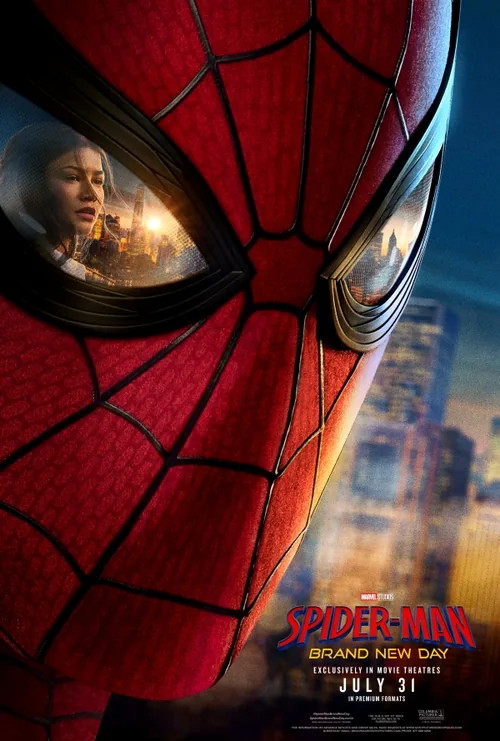
Quick facts
- Director
- Destin Daniel Cretton
- Writers
- Chris McKenna, Erik Sommers
- Producers
- Kevin Feige, Amy Pascal, Avi Arad, Rachel O'Connor
- Release
- 31 July 2026 (US); 27 July premiere
- Runtime
- 145 minutes
- Studios
- Columbia, Marvel Studios, Pascal Pictures
- Distributor
- Sony Pictures Releasing
- Music
- Michael Giacchino
- Budget
- $225 million
- Worldwide gross
- $2.523 billion
- Lead cast
- Tom Holland, Zendaya, Sadie Sink
- IMDb
- tt22084616 · 7.9/10
- Certificate
- PG-13
- MCU position
- 38th film
Place in the MCU and Spider-Man film history
After the spell
Spider-Man: No Way Home ended with an extraordinary compromise. To stop multiversal threats unleashed by Doctor Strange's spell, Peter asked that the world forget his identity entirely. The spell succeeded: MJ, Ned, Happy and everyone else no longer knew who Peter Parker was. He saved his city but lost his place in it. That ending was widely read as a reset to the character's essentials — a solitary hero, an unrecognised double life and a new beginning.
Brand New Day takes that reset literally. Four years have passed. Peter is no longer an Avenger, no longer in a relationship with MJ and no longer close to Ned. He lives in a small apartment, works independently and protects New York without the institutional support that once came with being Tony Stark's protégé. The title is both a reference to a famous Amazing Spider-Man story arc and a statement of intent: this is a fresh start built from the wreckage of the previous story.
A hybrid production
The film is a joint production between Sony Pictures and Marvel Studios, with Kevin Feige and Amy Pascal among the producers. That arrangement has defined the MCU Spider-Man films since Homecoming. The marketing surprise of Brand New Day was the scale of its crossover cast: Jon Bernthal's Punisher, Florence Pugh's Yelena Belova and Mark Ruffalo's Bruce Banner all appear, connecting Peter's street-level story to the wider MCU without turning the film into an Avengers ensemble piece.
Development and production
Getting the story right
A fourth MCU Spider-Man film was inevitable after the success of No Way Home, but its shape was not. The previous film had ended with a total reset, and audiences had strong opinions about which relationships should be restored. Chris McKenna and Erik Sommers returned as screenwriters, and Destin Daniel Cretton was hired to direct. Cretton's background — intimate character dramas such as Short Term 12 and the Marvel series Shang-Chi and the Legend of the Ten Rings — made him a logical choice for a story about identity and control.
Justin Kuritzkes also worked on the script with Cretton and received an offscreen “additional literary material” credit. The final film reportedly leans harder into character drama than its MCU Spider-Man predecessors, using the evolving-powers plot as a metaphor for adolescence, grief and the loss of control that follows a life-changing decision.
Casting
Tom Holland returns as Peter, with Zendaya as MJ and Jacob Batalon as Ned. Both are now outside Peter's life as a consequence of the spell, and their scenes are built around the awkwardness of an unrecognition that is not quite the same as absence. Sadie Sink joins as Jean Grey, a young mutant searching for her sister, and her role gives the film an emotional counterweight to Peter's isolation.
Jon Bernthal reprises Frank Castle, a vigilante whose methods serve as a warning about what Peter could become. Florence Pugh returns as Yelena Belova, now calling herself Black Widow, and Mark Ruffalo appears as Bruce Banner, whose scientific work helps Peter manage his changing abilities. Marisa Tomei appears as Aunt May in a memory, and Michael Mando returns as Mac Gargan / Scorpion.
Filming and design
Principal photography took place in 2025, with extensive location work in Glasgow standing in for New York City. Photos from the Glasgow set — armoured vehicles, NYPD cars and city taxis — circulated widely during production and became part of the film's pre-release identity. The production also used a deliberately tactile approach to Spider-Man's equipment: a 3D printer in Peter's apartment produces the suit, a detail that was displayed in a museum-style replica after release.
Plot
Spoiler notice: this section describes the complete plot, including the ending.
A hero without a name
Four years after the spell, Peter protects New York as an unrecognised Spider-Man. He has defeated criminals such as Mac Gargan and the Hand while continuing to visit Aunt May's grave. When Frank Castle causes collateral damage during an incident at a Department of Damage Control prison, Peter stops him — a confrontation that establishes the two men's very different ideas about justice.
Yelena Belova tells Peter that several DODC facilities have been attacked by someone searching for “V-Max”. Around the same time, Peter sees MJ with a new boyfriend and his powers begin to change. His senses sharpen, his eyes turn black, and organic spinnerets develop in his wrists. During a fight he loses control and beats Gargan brutally, injuring a police officer. The sequence marks the moment when Peter's greatest asset becomes a source of fear.
Jean Grey and the telepath
With help from Bruce Banner, Peter builds an inhibitor to suppress his powers. A telepath tracks him to his apartment, learns about MJ from an unsent letter and possesses her. Peter discovers that the intruder is Jean Grey, a young mutant looking for her sister Sara. He brings MJ to Castle's hideout for protection. Jean attacks DODC headquarters using a possessed Banner, causing the Hulk to reappear; Peter calms the Hulk and uses a universal inhibitor to block Jean's powers.
Peter later learns that DODC director Bill Metzger lied about Sara. She was Jean's sister, another telepath kidnapped by the agency. Infiltrating a DODC facility on Roosevelt Island, Jean realises that “V-Max” was the weathered label on the air vent of her cell — the last thing Sara saw before dying. Jean creates a psionic field that freezes everyone except Peter.
Embracing the evolution
Peter removes his inhibitor and accepts the changes to his body. He defeats the Hand and stops Jean from killing Metzger. Jean enters his mind and sees a memory of May telling him that she loves him for who he is. They reconcile over their shared losses. Peter shields Jean from a distant shot by Castle and is critically injured, but Jean keeps him alive remotely with her powers.
In the ending, Jean leaves the city, Metzger disappears and DODC is investigated. Peter vows not to do everything alone, and later reintroduces himself to Ned with their old handshake. It is a small gesture, but it completes the emotional arc: the hero who chose isolation at the end of No Way Home chooses connection again.
Cast and characters
| Actor | Character | Role in the story |
|---|---|---|
| Tom Holland | Peter Parker / Spider-Man | Anonymous protector of New York |
| Zendaya | Michelle “MJ” Jones-Watson | Peter's former girlfriend |
| Sadie Sink | Jean Grey | Telepathic mutant searching for her sister |
| Jacob Batalon | Ned Leeds | Peter's former best friend |
| Jon Bernthal | Frank Castle / Punisher | Vigilante and cautionary figure |
| Florence Pugh | Yelena Belova / Black Widow | New Avenger and ally |
| Mark Ruffalo | Bruce Banner / Hulk | Scientist and ESU professor |
| Tramell Tillman | Bill Metzger | Head of the Department of Damage Control |
| Marisa Tomei | May Parker | Peter's aunt, in memory |
| Michael Mando | Mac Gargan / Scorpion | Recurring criminal antagonist |
Themes and interpretation
Identity after erasure
The spell in No Way Home solved a practical problem by erasing Peter from everyone's memory. Brand New Day asks what that solution cost. Peter is free to live a normal life, but normality is defined here by absence: no one knows him, no one calls him and no one expects him. The film treats anonymity not as liberation but as a condition that gradually becomes its own prison.
Isolation versus connection
Peter's decision to stay away from MJ and Ned was an act of love in the previous film. Here it reads as self-protection. The ending's handshake with Ned is therefore the story's real resolution: Peter does not regain his old life, but he stops refusing it. The film's argument is not that a hero needs a team, but that a person cannot survive indefinitely without being known.
Power and loss of control
The evolution of Peter's abilities — organic webbing, black eyes, heightened senses and sudden violence — externalises a psychological state. He is a young man whose life has been repeatedly rewritten by other people's decisions, and his body begins to behave as unpredictably as his circumstances. The inhibitor Banner builds is a literal attempt to suppress what cannot be suppressed, and the climax comes when Peter stops trying.
Justice and collateral damage
Frank Castle functions as a dark mirror. He solves problems decisively and accepts the consequences, while Peter is tormented by a single injured officer. The film uses their contrast to ask whether restraint is strength or weakness. Jean's arc offers a third position: she has every reason to punish those who destroyed her family, but her resolution depends on refusing to become what they were.
Institutional violence
The Department of Damage Control is the film's systemic antagonist. It was created to manage superhuman incidents but has become a site of experimentation and concealment. The scenes on Roosevelt Island give the story a bureaucratic horror dimension: the worst acts are committed in the language of procedure. That choice connects the film to a longer tradition of superhero stories about the state's fear of extraordinary people.
Music
Michael Giacchino composed the score. Giacchino's MCU work includes Doctor Strange, Spider-Man: Homecoming and Spider-Man: No Way Home, making him one of the most consistent musical voices in Peter Parker's screen history. His themes for Homecoming balanced teenage energy with a distinctly orchestral sense of wonder, and that vocabulary returns here in a darker, more mature form.
The score has two main tasks. It provides continuity with earlier films through familiar motifs, and it supports the story's more unsettling material — the body-horror elements of Peter's powers, the confined spaces of DODC facilities and the telepathic intrusion into MJ. Giacchino's writing is most effective when it holds those registers together, allowing a single cue to move from intimacy to menace.
Sound design also matters in a film built around heightened senses. Peter's evolving perception is conveyed through layered ambient detail, giving the audience a version of what he hears and notices. The effect is subtle in quiet scenes and overwhelming in action sequences, reinforcing the idea that his powers have become both a gift and a burden.
Release and marketing
The film premiered at the Dolby Theatre in Los Angeles on 27 July 2026 and opened in the United States on 31 July. Its release positioned it as the summer's dominant superhero event, with IMAX and premium-format presentations supporting the box-office campaign. Sony Pictures Releasing handled distribution worldwide.
Marketing emphasized the title's promise of a fresh start. Early material showed Peter alone in New York, avoiding the people who once knew him. Later trailers revealed the ensemble cast — particularly Bernthal's Punisher, Pugh's Yelena and Ruffalo's Hulk — while withholding the details of Jean Grey's role. That sequencing allowed the campaign to move from isolation to connection, mirroring the film's own arc.
An extended cut titled [Brand New] Brand New Day was announced for release on 4 December with additional scenes, including material cut from the theatrical version. The extended release extends the film's commercial life into the year-end and gives audiences a reason to revisit the story after its initial run.
Box office
With a reported budget of $225 million, Spider-Man: Brand New Day grossed approximately $2.523 billion worldwide. It became the highest-grossing Spider-Man film, surpassing No Way Home, the highest-grossing film of 2026 and the third-highest-grossing film of all time. It also topped the United States and Canadian market.
Those figures confirm the strength of the Spider-Man brand at its highest point. The film benefited from the MCU's global infrastructure, the recognition of Tom Holland's version of the character and a release window with limited direct competition. Premium-format screenings contributed significantly, and repeat viewing appears to have been strong in the opening weeks.
The result also strengthens Sony's position in the long-running arrangement with Marvel Studios. The joint production model has now delivered one of the biggest films in cinema history, and the commercial performance makes further collaboration highly likely. As with all box-office reporting, final figures vary between trackers, but the scale and ranking are not in dispute.
Critical reception
Critical response was largely positive. IMDb lists a rating of about 7.9/10 from more than 389,000 votes, with a Metascore of 66. Reviewers praised Tom Holland's performance, the action choreography and the decision to tell a more mature, character-driven story rather than simply escalating the spectacle. Sadie Sink's Jean Grey and Jon Bernthal's Punisher were also frequently singled out.
The reservations were predictable for a film of this scale. Some critics found the DODC conspiracy material less compelling than the personal story, and others felt that the large supporting cast diluted Peter's centrality. The body-horror elements of the powers storyline divided opinion, with some reviewers seeing them as a bold choice and others as an uncomfortable detour.
“The film's best idea is that a fresh start is not the same as a clean slate. Peter is free of his old life, but he still carries it everywhere.”
Audience response was even warmer than critical response. The film's high user rating and extraordinary box-office performance suggest that viewers connected strongly with its emotional resolution — particularly the final handshake with Ned, which functions as a quiet answer to four years of isolation.
Debates and open questions
Was the reset respected?
After No Way Home, audiences were split on whether Peter should regain his relationships. Brand New Day chooses a middle path: the spell is not undone, but Peter chooses to re-enter Ned's life. Some viewers found that satisfying; others felt it complicated the clean ending of the previous film.
Too many heroes?
The presence of Punisher, Black Widow, Hulk and Jean Grey gave the film an unusually large crossover cast for a Spider-Man solo entry. Supporters argued that each character serves Peter's arc; critics saw the ensemble as evidence of franchise dependency. The film's commercial success suggests the strategy worked, but the debate continues among fans.
The powers evolution
Organic web generation and black eyes mark a significant departure from earlier MCU Spider-Man designs. Long-time comics readers recognised references to earlier storylines, while newcomers sometimes read the changes as horror imagery. The mixed response reflects a broader question about how far a superhero film can push its central character's body before audiences become uncomfortable.
DODC as antagonist
The Department of Damage Control has appeared in earlier MCU projects, but here it becomes the central institutional threat. Some reviewers welcomed the continuity; others found the organisation less dramatically compelling than a traditional villain. The film's answer is to make the system's cruelty procedural rather than flamboyant, which works better in some scenes than others.
Legacy and the next chapter
The film's box-office performance places it among the most successful superhero films ever released. It re-established Tom Holland's Spider-Man as the MCU's most reliable solo draw and confirmed that a street-level story can carry global audience interest when anchored by a strong character arc.
Its place in the MCU is also significant. By connecting Peter to Jean Grey, Frank Castle, Yelena Belova and Bruce Banner without re-forming the Avengers, the film suggests a model for future solo entries: the wider universe can appear in service of a personal story rather than replacing it. The ending's vow — not to do everything alone — leaves the door open to a more collaborative next chapter.
The extended cut, [Brand New] Brand New Day, released on 4 December 2026, adds further material and confirms that the film's story has enough surplus to support another version. No subsequent Spider-Man film had been officially confirmed at the time of writing, but the commercial and critical response makes further instalments highly likely.
Character focus
Peter Parker: the anonymous year
Tom Holland's performance is less buoyant than in earlier films. Peter is funny when required, but his default state is watchfulness. The most revealing scenes are quiet: a visit to May's grave, an unopened letter to MJ, the moment he decides not to approach Ned. Holland plays the absence of a social life as a physical condition, and the final handshake lands because he has made four years of solitude visible.
Jean Grey: grief with power
Sadie Sink's Jean is the film's strongest new character. Her search for Sara gives the plot urgency, but her emotional state gives it weight. Jean is dangerous because she has been denied an explanation, not because she enjoys force. The shared memory of May allows Peter and Jean to recognise each other as people who have lost the person who made them feel known.
Frank Castle and Yelena: two versions of survival
Bernthal's Punisher and Pugh's Yelena each represent a way of living with violence. Castle has accepted it as a vocation; Yelena has attempted to turn it into service. Peter stands between them, still convinced that restraint matters even when it costs him. Their presence broadens the film without shifting its focus.
Bruce Banner: the scientist as mentor
Mark Ruffalo's Banner provides the film's practical solution — an inhibitor — and a dark warning about what happens when a persona takes over. His regression into Savage Hulk under Jean's influence is one of the film's most striking action sequences, and it gives Peter a visible model of a power that has escaped its owner's control.
Comparison with No Way Home
No Way Home was a multiversal event built around nostalgia: earlier Spider-Man actors returned, old villains were redeemed or defeated, and Peter's identity was publicly erased. Brand New Day is smaller in scope but more intimate in design. Its conflicts are personal, institutional and bodily rather than cosmic. The change is reflected in the runtime — 145 minutes against No Way Home's 148 — but the difference is tonal rather than numerical.
Where the previous film gave Peter a grand solution to an impossible problem, this one asks him to live with an ordinary consequence. He cannot undo the spell, and he cannot force MJ or Ned to remember. The emotional resolution is correspondingly modest: one conversation, one handshake, one decision to stop disappearing. That modesty is the sequel's defining strength.
The action also changes. No Way Home staged large battles in symbolic locations; Brand New Day favors close-quarters fights, confined spaces and the unsettling physicality of Peter's evolving powers. Jean's psionic field and the Hulk's rampage provide spectacle, but the most memorable sequence may be Peter's loss of control against Gargan — a fight that frightens him more than his enemies.
Design, action and technical craft
The production's visual design separates the film's three worlds. Peter's apartment and the New York streets are grounded, with natural light and practical textures. DODC facilities are cold, controlled and geometrically rigid. Jean's psionic spaces are fluid and luminous, a visual language that belongs to her rather than to the police state pursuing her.
Action choreography uses Peter's changing body as a source of novelty. Organic webbing changes how he moves between buildings, while the black-eye sequences alter the audience's sense of what he is seeing. The fight against the Hand on Roosevelt Island is the film's largest set piece, but it is built from repeated spatial beats that keep the geography legible even at speed.
Costume design continues the MCU Spider-Man tradition of blending comic accuracy with wearable detail. The suit is produced by a 3D printer in Peter's apartment — a small production-design choice that reinforces his independence from Tony Stark's legacy. The absence of a mentor figure is felt in the equipment as much as in the dialogue.
Antagonists and institutions
Jean Grey as a tragic figure
Jean Grey is the film's most important antagonist, but the story is careful to make her grievance legitimate. Her sister Sara was taken by the Department of Damage Control, and the official account of what happened was a lie. Jean's investigation is an act of love that becomes a form of possession — literally, when she takes over other people's bodies to find answers. That combination makes her both sympathetic and dangerous, and it gives Sadie Sink a role that resists simple categorisation.
The moment Jean realises that “V-Max” was the faded label on a cell vent is the film's most brutal piece of exposition. There is no superweapon, no grand conspiracy at the centre of her search — only the last object her sister saw before dying. The revelation reframes all of Jean's violence as an attempt to recover a small, ordinary detail. It is also the point at which Peter stops treating her as a threat and starts treating her as a person.
The Department of Damage Control
DODC began in earlier MCU stories as a bureaucratic response to superhuman collateral damage. Here it has become something more sinister: an institution that detains, experiments on and disappears people with abilities. Bill Metzger, its director, is not written as a mustache-twirling villain. He lies because the system he runs depends on secrecy, and he is prepared to sacrifice individuals to preserve it.
That choice gives the film a different kind of tension from a conventional superhero battle. Peter cannot punch an institutional process. He has to infiltrate a facility, uncover records and persuade Jean that revenge on Metzger will not restore her sister. The film's most pointed idea is that the damage control agency has become the thing it was created to control.
Frank Castle as a warning
Frank Castle appears briefly but functions as a structural counterweight. He represents the version of Peter that might have emerged from four years of isolation: effective, unaccountable and willing to accept collateral damage. When Peter stops him at the prison, the scene is not a disagreement about tactics but about what a hero owes to strangers. The film returns to that question in the climax, when Castle shoots at Jean and Peter takes the bullet.
The extended cut
The film's announced extended version, [Brand New] Brand New Day, was released on 4 December 2026. Its title plays on the original's name by repeating the phrase “Brand New” — a joke that also signals a second version of a story already about reinvention. The extended cut includes additional scenes, including material featuring Claire Temple that was removed from the theatrical release.
The practice of releasing an extended version has become a significant part of the superhero film economy. It gives studios a second release window, rewards dedicated fans and allows material that did not fit the theatrical pacing to find an audience. In this case, the extra material is especially interesting because the theatrical film's central theme is incompleteness: Peter's life is full of things left unsaid. An extended cut that restores scenes can be read as an extension of that idea.
For viewers deciding which version to watch, the theatrical cut remains the cleaner narrative. The extended edition is better understood as a companion text — a way to spend more time in a story whose emotional resolution is deliberately understated. Its existence does not change the film's ending, but it reinforces the sense that this particular Brand New Day has more than one form.
Cultural context
Spider-Man has always been a character defined by ordinary life. Unlike many superheroes, Peter Parker's central conflict is not whether he can defeat a villain but whether he can hold together a job, a family and a moral code while doing so. Brand New Day returns to that foundation after two films that pushed the character toward superhero-team spectacle and multiversal stakes.
The title's reference to the “Brand New Day” comics arc is significant. In the 2008 storyline, Peter and MJ make a deal that erases their marriage from reality, restoring a more conventional single status quo. The film does something similar with the spell in No Way Home, but it places the emotional cost at the centre rather than treating it as a administrative reset. The result is a superhero story that is unusually interested in what a continuity change feels like from the inside.
The film also arrives at a moment when superhero cinema is under pressure to justify its scale. Its answer is not to reduce the spectacle — the box office and the action sequences are enormous — but to anchor that spectacle in a recognisable emotional situation: a young adult who has pushed everyone away and does not know how to ask them back. That choice helps explain why reviews were stronger than for many comparable blockbusters.
The crossover cast serves a similar purpose. Punisher, Black Widow, Hulk and Jean Grey are not decorative cameos; each represents a different relationship to power and loss. The film uses them to test Peter's decisions rather than to expand a brand. Whether that ambition is fully realised is debatable, but it distinguishes the movie from a simple franchise handoff.
Filming locations and production design
Principal photography took place during 2025, with Glasgow serving as the primary stand-in for New York City. The production's presence in Glasgow became a local talking point: set photographs showing NYPD cars, taxis and armoured vehicles circulated online, giving audiences an early look at the film's grounded visual approach. interiors were built to contrast domestic warmth with institutional coldness, and that contrast shapes the film's visual rhythm.
Peter's apartment is the film's most important designed space. It is small, cluttered and personal, with the suit 3D printer occupying a place once reserved for ordinary household objects. The apartment's intimacy matters because so much of the story is about privacy: Jean enters it uninvited, MJ is brought there for safety and Peter's unsent letter reveals what he cannot say face to face.
The DODC facilities use a harsher palette — concrete, glass, fluorescent light and long corridors. Roosevelt Island, where Jean discovers the truth about her sister, is staged almost like a laboratory horror sequence. The Hand's ninja scenes introduce a third visual mode, with darker textures and faster cutting. Together these spaces give the film a sense of geographical progression: from Peter's private world to a system that has swallowed other people's private worlds.
The suit design continues the MCU's practical approach. Rather than presenting the equipment as a gift from a wealthy mentor, the production makes it something Peter builds himself. That decision is consistent with the story's emphasis on independence, and it visually distinguishes this chapter from the Homecoming era, when Stark technology defined Peter's arsenal.
Sources and further reading
- Wikipedia — Spider-Man: Brand New Day: credits, cast, plot, release, box office and reception.
- IMDb — tt22084616: rating, runtime, certificate and key art.
- IGN — Spider-Man: Brand New Day: key art and film background.
- Marvel.com: official film and MCU information.
Editorial note: this is an independent reference article. It is not affiliated with Marvel Studios, Sony Pictures or the film's rights holders. Image credits and the removal process are described on the DMCA page.
Frequently asked questions
What is Spider-Man: Brand New Day?
It is a 2026 superhero film directed by Destin Daniel Cretton and starring Tom Holland. It is the fourth MCU Spider-Man film and continues directly from Spider-Man: No Way Home.
When was it released?
The film premiered on 27 July 2026 and was released in the United States on 31 July 2026.
How long is it?
The theatrical runtime is 145 minutes.
Who is in the cast?
Tom Holland, Zendaya, Sadie Sink, Jacob Batalon, Jon Bernthal, Florence Pugh, Mark Ruffalo, Tramell Tillman and Michael Mando appear, with Marisa Tomei returning as May Parker.
What is the plot?
Four years after the world forgot Peter Parker, his powers evolve while a telepathic mutant named Jean Grey draws him into a conflict with the Department of Damage Control.
Who composed the music?
Michael Giacchino composed the score.
How much did it earn?
Reported worldwide gross is approximately $2.523 billion, making it the highest-grossing Spider-Man film and the third-highest-grossing film of all time.
What is the extended cut?
An extended version titled [Brand New] Brand New Day was released on 4 December 2026 with additional scenes.
What did critics say?
Reviews were largely positive, praising Tom Holland's performance, the action and the mature character focus. IMDb users rated it about 7.9/10.
Is this website official?
No. This is an independent informational reference site with no affiliation to Marvel, Sony or the filmmakers. Sources and an image-removal process are provided on the DMCA page.
Community
Join the discussion
Have a thought about the film or this article? Leave a comment. Your name is displayed, and if you add a website it will be linked with a
nofollowattribute. Basic HTML is supported:<p>,<strong>,<em>,<a>, lists and blockquotes.Comments update live. New posts appear automatically without refreshing.
No comments yet. Be the first to start the conversation.
By commenting you agree to the Terms of Use. See the Privacy Policy for how your data is handled.